DECLASSIFIED
Thomas Kendrick
THE LISBON POSTMAN
The rain poured down in icy sheets as Thomas Kendrick cycled through the narrow streets of Lisbon on January 23rd, 1943. The leather bag slung across his chest felt unusually heavy today—not from the letters and packages inside, but from the weight of knowledge no ordinary postman was meant to possess. His breath formed small clouds in the frigid morning air as he pedaled harder, his eyes constantly scanning the shadowy doorways and alleys. The 42-year-old postal worker had memorized every brick, every cobblestone on his route through the Portuguese capital, a city now overflowing with refugees, diplomats, and spies as the fires of World War II raged across Europe.
He slowed his bicycle as he approached the nondescript apartment building at Rua da Prata 67, his trembling fingers reaching for the bundle of letters in his bag. What happened in the next seven minutes would alter the course of Allied intelligence operations across the continent. Thomas dismounted, adjusted his postal cap, and made a decision that violated every protocol in the postal service handbook. No one in the British intelligence community knew that one postman's seemingly insignificant choice that rainy morning would unravel the largest German spy network in Europe and potentially save thousands of Allied lives.
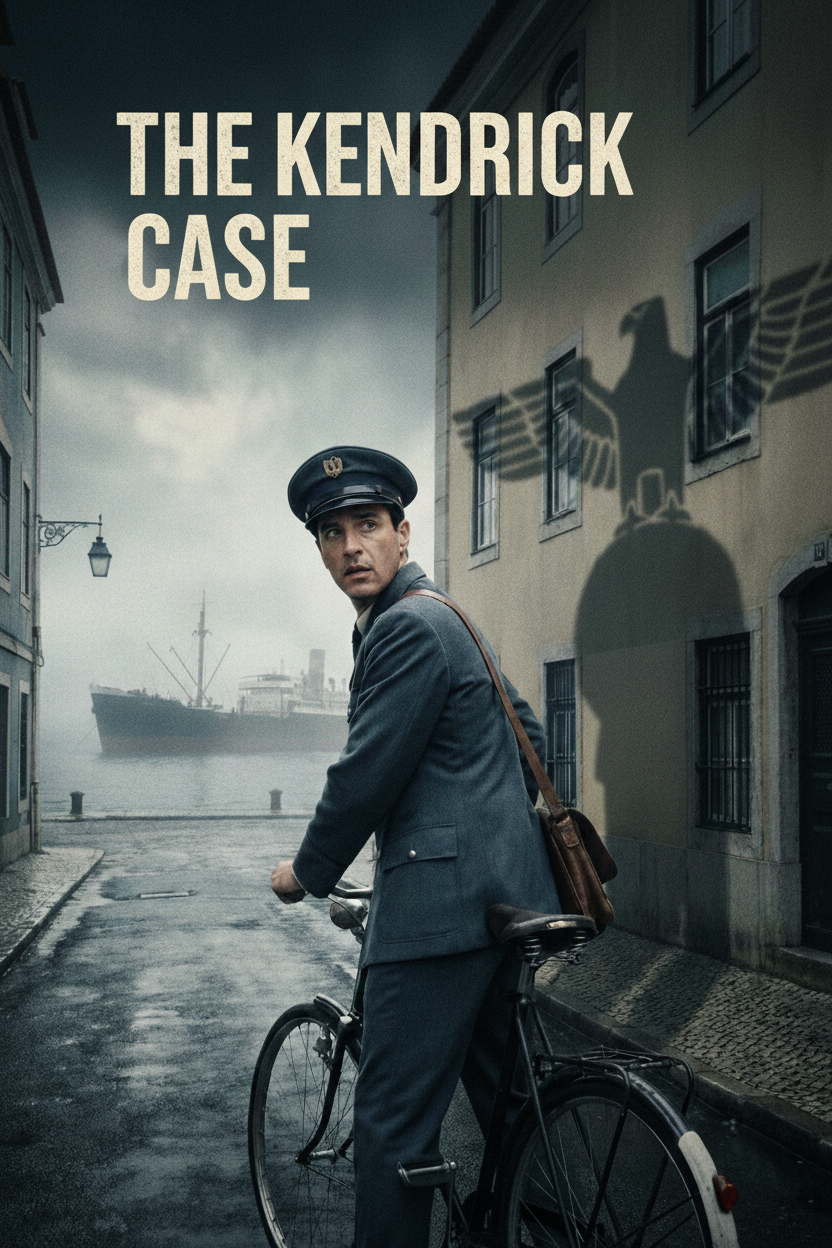 Exhibit A: Archival depiction of the Lisbon Postman
Thomas Kendrick had not been born to the world of international espionage and counter-intelligence. His story began 42 years earlier in the small fishing village of St. Ives, Cornwall, where his father mended nets and his mother worked at the local bakery. The oldest of five children, young Thomas grew up in a modest stone cottage overlooking the harbor. His childhood was marked by simple pleasures—helping his father with the nets, collecting seashells along the shore, and delivering fresh bread from his mother's workplace to neighbors too elderly to make the trip themselves. It was these early delivery routes that perhaps foreshadowed his future career.
Thomas was a curious child, always asking questions about the travelers and summer visitors who came to their small coastal town. "Why do you always talk to strangers, Thomas?" his mother would ask with a mixture of concern and amusement. "Because everyone has a story worth knowing," he would reply. This natural inquisitiveness, combined with an exceptional memory for faces and details, made him stand out among his peers.
When Thomas was 17, his father's fishing boat capsized during a sudden storm. The tragedy left the family without their primary breadwinner, forcing Thomas to abandon his education and seek full-time employment. He found work at the local post office, sorting mail and occasionally delivering packages on foot. His reliability and attention to detail quickly earned him praise from the postmaster. "You have a gift, Thomas," the elderly postmaster told him. "You remember every address, every name, without even checking your logs. The Royal Mail Service needs men like you."
By 1923, at the age of 22, Thomas had secured a position with the Royal Mail in London. He took night classes in languages, developing proficiency in French and later Portuguese. When the opportunity arose in 1937 for a special postal liaison position at the British Embassy in Lisbon, Thomas applied immediately. Portugal's neutral status made it a critical hub for international mail routing, and the embassy needed someone with impeccable credentials and language skills. His appointment came just as Europe was sliding toward conflict.
After arriving in Lisbon, Thomas quickly integrated himself into the local community. He began delivering mail along routes that included numerous embassies, consulates, and the residences of diplomats. His unassuming presence and official postal uniform granted him access to buildings that would otherwise be highly restricted. People barely noticed the middle-aged Englishman delivering their mail, which made him virtually invisible—the perfect cover for what would eventually become his second, unofficial duty.
Thomas married a local woman, Maria Santos, in 1939, just months before Germany invaded Poland. What his neighbors didn't know was that Thomas had begun to notice patterns in the mail he delivered—peculiarities that his methodical mind flagged as unusual. He had no idea that soon those instincts would be all that stood between the Allies and a catastrophic intelligence failure.
By 1942, Portugal had become one of the most crucial neutral territories in the European conflict. Its capital, Lisbon, served as the last open gateway between Nazi-occupied Europe and the free world. The city had transformed from a sleepy Iberian port into a teeming center of espionage, where operatives from both Axis and Allied powers conducted their shadow war under the thin veneer of diplomatic protocol.
The German Abwehr, their military intelligence service, had established a significant presence in the Portuguese capital under the direction of Admiral Wilhelm Canaris. The Abwehr had created a network of informants and agents throughout the city. Their primary mission was intelligence gathering about Allied shipping convoys in the Atlantic—information that would be passed to U-boat commanders, resulting in devastating losses for the Allies in the Battle of the Atlantic. They poured resources into expanding their Lisbon operation, creating what would later be codenamed the *Iberian Spider*, a vast network of agents spread across Portugal and neighboring Spain.
In London, the Admiralty was growing increasingly frustrated. In a classified memo dated December 12th, 1942, Admiral Sir Dudley Pound wrote: "The continued leakage of convoy information from Lisbon represents an intolerable threat to our Atlantic operations... The source must be identified and neutralized with extreme urgency."
What neither the British intelligence chiefs nor the German Abwehr realized was that the key to unraveling this deadly spy network would come from the observations of a humble postman. It began in October 1942 when Thomas observed that certain addresses on his route were receiving an unusual volume of mail from seemingly unrelated sources. The envelopes bore different return addresses and postmarks, yet Thomas recognized something odd: the weight and dimensions of these envelopes were remarkably consistent.
"Something's not right about these letters," he mentioned casually to his wife Maria one evening. "Six different senders writing to the same four addresses, and every envelope feels exactly the same weight in my hand. They're all handwritten, all on the same quality paper, and they're going to apartments, not businesses."
Over the next several weeks, Thomas noted that they arrived with predictable timing—always three days before major Allied shipping convoys departed from British ports. One of the addresses receiving these suspicious letters was a third-floor apartment at Rua da Prata 67. The recipient was listed as Miguel Santos, ostensibly a Portuguese art dealer. In early December, Thomas spotted the supposed art dealer entering the rear of the German consulate through a service entrance.
These observations might have remained private suspicions had Thomas not developed a casual friendship with James Westfield, a junior attaché at the British Embassy who was, in fact, an MI6 officer. On December 28th, 1942, Thomas shared his observations with Westfield. What Thomas didn't know was that his words had electrified British intelligence. Within 24 hours, MI6 had begun quietly investigating the addresses Thomas had identified.
By mid-January 1943, British intelligence had confirmed that at least three of the addresses were indeed linked to German intelligence operations. However, they needed concrete evidence of the content. On the evening of January 22nd, James Westfield arrived unannounced at Thomas's apartment. "We need to know what's in those letters," Westfield said quietly. "And we need to identify everyone involved in this network. Lives depend on it."
"You want me to intercept the mail?" Thomas said flatly. "That would violate every oath I've taken as a postal worker." After hours of discussion and soul-searching, Thomas agreed to help. The plan was simple but extremely risky: Thomas would divert the suspicious letters briefly to Westfield, British intelligence would open and photograph them, reseal them, and return them to Thomas for normal delivery.
And so, on that rain-soaked morning of January 23rd, 1943, Thomas found himself slipping into a narrow maintenance corridor at Rua da Prata 67. "Delivery," Thomas whispered. An MI6 operative disguised as a maintenance worker took the bundled letters and handed Thomas an identical bundle. "Ten minutes," the man murmured. Nine minutes later, Thomas returned to the corridor, retrieved the resealed original letters, and proceeded to complete his deliveries, sliding the letter into Miguel Santos's mailbox.
Inside a secluded room at the British embassy, cryptographers poured over the photographed contents. "It's a book cipher," explained a bespectacled woman who had been a classics professor at Oxford. That reference book was identified within hours: a specific edition of *Don Quixote* that had been distributed to German agents throughout the Iberian Peninsula.
Once the code was broken, the content of the messages became clear. They contained detailed information about Allied shipping convoy compositions, departure times, routes, and escort strengths. Most alarmingly, the decrypted messages revealed that the network was far larger than British intelligence had suspected, referencing at least 27 other agents operating throughout Portugal and Spain.
British intelligence faced a choice: arrest the network immediately or feed them false information. They chose the latter. They needed Thomas Kendrick to deliver forged letters containing misinformation designed to lead German U-boats away from actual convoy routes. "I'll do it," Thomas said simply.
The operation commenced on January 26th. For the next three weeks, Thomas lived in a state of constant tension, delivering masterpieces of deception containing critically wrong details about convoy routes. The climax of the operation came on February 2nd. Thomas had just completed a delivery when he encountered Miguel Santos face-to-face in the lobby. Santos tested him, handing him a gratuitous tip in an envelope. Inside the envelope was Portuguese currency and a card reading: *For your continued discretion with my personal correspondence.*
The modified letters had their intended effect. On February 10th, a Wolfpack of 11 U-boats was positioned to intercept a Glasgow convoy—except they were waiting 300 nautical miles north of the convoy's actual route. The convoy reached its destination in North Africa without losing a single ship.
On February 15th, in a coordinated operation involving British intelligence, Portuguese police, and American OSS agents, 34 members of the Iberian Spider Network were arrested simultaneously across Lisbon. Admiral Canaris' entire Iberian intelligence apparatus had been compromised, dealing a severe blow to Germany's ability to track Allied shipping.
The morning after the arrests, Thomas resumed his postal route as if nothing had happened. There would be no medals, no public recognition, not even a formal acknowledgement of his service. Thomas and Maria remained in Lisbon until 1945. His personnel file contained a cryptic notation: *Rendered special services to the crown, 1943 Lisbon station*.
On a rainy afternoon in April 1962, James Westfield found Thomas sitting on a park bench in London and handed him a small package wrapped in plain brown paper. Inside was a leather-bound first edition of *Don Quixote*. A handwritten note inside read: *To the postman who delivered us victory. With the enduring gratitude of those who know. Admiralty Intelligence Division, 1943.*
"We've calculated that your actions saved approximately 23,000 Allied lives," Westfield revealed. Thomas shook his head in disbelief. "I was just a postman doing what seemed right."
Conservative estimates suggested that Thomas's actions had saved at least 74 vessels from destruction. The true power of Thomas Kendrick's legacy lies not in celebrating him as an exceptional hero, but in recognizing that his choice is one that presents itself to each of us. He demonstrated that systems of evil depend not only on the active participation of true believers, but on the silent compliance of ordinary people who simply follow procedures.
The rain had stopped by the time Thomas finished his rounds that February day in 1943. He went home to Maria, ate dinner, listened to the radio, and slept in his own bed, rising the next morning to begin his rounds again. The world would not know for decades how the humble routines of one observant postman had unraveled the largest spy ring in Europe. And perhaps that, in the end, is the true measure of quiet heroism: not that it seeks recognition, but that it does what must be done, and then continues on its way, content in the knowledge that some letters, once delivered, can never be recalled.
* * *
AUTHOR'S NOTE:
Would you have broken the rules as Thomas did? Would you have risked everything to intercept those letters, or would you have continued your rounds following the regulations that had guided your entire career? Share this story so others remember what courage really means.